
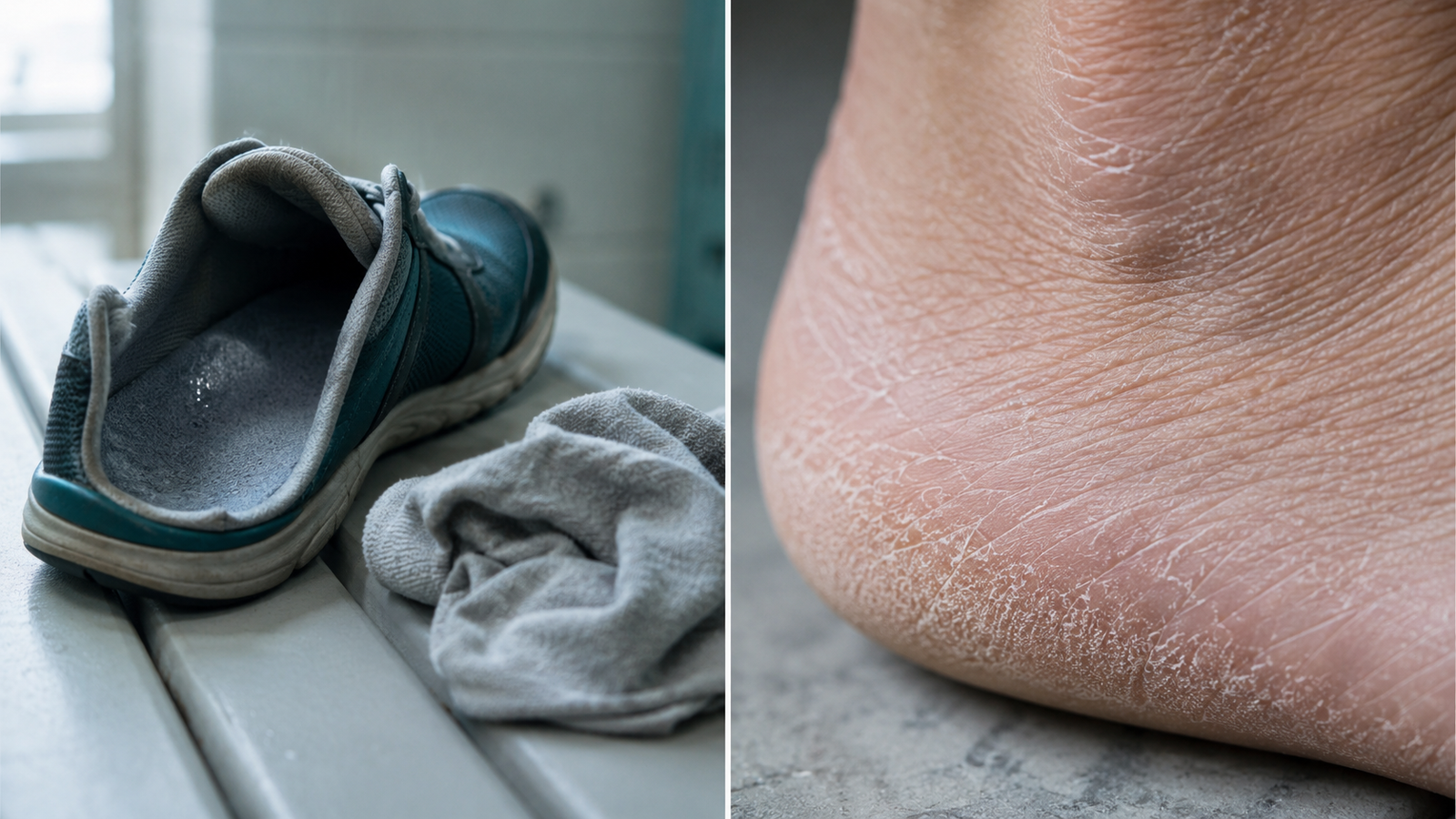
Athlete’s foot is a fungal infection of the skin, and the name is misleading — you don’t have to be an athlete to get it. Locker rooms and sweaty shoes do raise the risk, which is where the name came from, but most cases have nothing to do with sport. The fungus responsible lives happily in the same warm, damp conditions your shoes create all day, which is why it’s one of the most common skin infections there is.
If you have diabetes, neuropathy, or poor circulation, don’t self-treat this. A crack in the skin between the toes is the most common entry point for a spreading leg infection, and on an at-risk foot that can escalate quickly. Have it looked at instead.
Most people picture itchy peeling between the toes, but athlete’s foot shows up in three fairly distinct ways — and knowing which one you’re looking at explains a lot about why a treatment did or didn’t help. These are a rough orientation, not a way to diagnose yourself — the next section covers the conditions that mimic all three.
This is the part worth slowing down on, because getting it wrong costs months. Several common conditions look almost identical — and one of them gets dramatically worse with the wrong treatment.
Don’t reach for a hydrocortisone cream on a foot rash you haven’t had identified. Over-the-counter hydrocortisone is a topical steroid. If the rash is fungal, a steroid settles the itch for a few days while the infection spreads and changes appearance, which makes it harder to recognize afterward. If a rash improved on a steroid cream and then got worse, that’s a reason to have it examined.
These are rough signs, not a diagnosis. They overlap often enough that if something on your foot hasn’t responded to a few weeks of appropriate care, the answer usually isn’t a stronger version of the same treatment — it’s finding out what you actually have. A persistent scaly patch on one foot that keeps failing antifungal cream occasionally turns out not to be an infection at all, which is why a lesion that won’t clear deserves an in-person look rather than another tube. A skin scraping examined in the office can usually settle it.
Confirmed athlete’s foot generally responds well to antifungal treatment, and most cases are managed with an over-the-counter topical. A few things determine whether it works:
Don’t use bleach, undiluted vinegar, hydrogen peroxide, or undiluted essential oils on broken or cracked skin. They damage healthy tissue and can turn a manageable problem into a wound.
People often ask about these, and it’s a fair question on a site that takes a holistic approach. Our article on coconut oil for fungal nails covers what that kind of approach can and can’t do. The short version: moisturizing oils can make dry, cracked skin feel more comfortable, but they do not clear a fungal infection and shouldn’t be used in place of treatment.
The same fungus that infects the skin can move into the nails, and once it does, the problem gets considerably harder to treat — nails are dense and slow-growing, so what takes weeks on skin takes many months on a nail. Treating athlete’s foot rather than living with it removes a reservoir of fungus that can reach the nail.
It also travels in the other direction — an untreated fungal nail can keep reseeding the skin, which is one reason athlete’s foot keeps returning for some people no matter how carefully they treat the skin itself.
Book an appointment if the skin is cracked, bleeding, or weeping; if it hasn’t improved after a few weeks of over-the-counter treatment; if it keeps returning; or if you’re not certain that’s what it is. If the skin became more irritated after starting an antifungal, stop using it and have it looked at.
Seek care the same day if you have any of these: sudden swelling or warmth, pus or drainage, redness that is spreading quickly, red streaking up the foot or leg, or chills and fever.
And if you have diabetes, neuropathy, or poor circulation, any skin change between the toes is worth an appointment rather than a wait-and-see — our diabetic foot care in Long Beach page explains why the threshold is lower for at-risk feet. The American College of Foot and Ankle Surgeons also has a plain-language overview of athlete’s foot.
Athlete’s foot and toenail fungus can pass back and forth, so a skin infection that keeps returning is worth checking alongside your nails. If your toenails have become thick or discolored, an exam and a nail culture can help confirm whether it’s fungal. If it is, our 6-Month Fungal Toenail Program builds on that testing with a structured plan that can include prescription antifungal options, in-office nail care, and prevention steps. Whether it fits you depends on your exam. You can also read about toenail fungus treatment in Long Beach.
It takes three main forms: soft, white, soggy skin between the toes (most often between the fourth and fifth); dry scaly pink skin across the sole and up the sides of the foot; or a crop of small itchy blisters on the arch or instep. Itching is common but not universal, and the sole pattern is frequently mistaken for ordinary dry skin.
First make sure that’s what it is: several conditions look like athlete’s foot, and the wrong treatment can make it worse. Once it’s confirmed, most cases respond to an over-the-counter antifungal. The two things that decide whether it works are finishing the full course rather than stopping when the itch does, and treating the whole foot rather than just the visible patch. Address your shoes at the same time, since reinfection from footwear is common. If you have diabetes, neuropathy, or poor circulation, have it examined rather than treating it at home. If it hasn’t improved after a few weeks, have it looked at rather than switching to something stronger.
They look very similar, and this matters more than most people realize: eczema is often treated with a topical steroid — including over-the-counter hydrocortisone — and putting a steroid on a fungal infection makes it spread while hiding how it looks. If you’re unsure, or if a rash got worse after a steroid cream, that’s a reason to have it examined rather than guessing.
Yes. The same fungus can move from skin into the nails, and nail infections are much slower and harder to treat. It works in reverse too — an untreated fungal nail can keep reinfecting the skin, which is why athlete’s foot sometimes keeps returning despite careful skin treatment.
It carries more risk than it does on an otherwise healthy foot. Cracks in the skin between the toes are the most common entry point for a spreading leg infection, and reduced sensation means damage can progress without pain to warn you. If you have diabetes, neuropathy, or poor circulation, have any skin change between the toes examined rather than treating it at home.
Be educated, get empowered, and encourage others today!
This article is for general information only and is not medical advice, diagnosis, or treatment. Individual results vary. Rashes and scaling on the feet have several possible causes that look alike, and only an in-person evaluation by a licensed podiatrist or physician can determine what you have and what is appropriate for you. Do not apply a topical steroid — including over-the-counter hydrocortisone — to a foot rash that has not been identified by a clinician. If you have diabetes, reduced sensation, or poor circulation, or if the skin is cracked, bleeding, or the redness is spreading, seek care promptly. Reviewed by Dr. S Don Kim, DPM, FACFAS.