
If you’ve searched whether UV light kills toenail fungus, you’ve probably seen confident yes-or-no answers pointing in opposite directions. Both are half right, and the gap between them is where people waste money. Ultraviolet light really does kill fungus in a laboratory dish. Getting that to happen inside a thickened toenail on a living foot is a different problem, and no UV device has been shown to do it. It is also not a harmless thing to experiment with — see the safety section below.
Ultraviolet light comes in three bands. UVA and UVB are the parts of sunlight that tan and burn you. UVC is the shortest wavelength, and it’s the germicidal one — it damages the DNA of microorganisms so they can’t replicate. That’s why UVC lamps are used to disinfect surfaces, air, and water.
The atmosphere absorbs virtually all of the sun’s UVC before it reaches the ground, so the germicidal band only comes from artificial sources. If you’re interested in what natural daylight does and doesn’t do for nails, that’s a separate question we cover in do fungal nails need sunlight — this article is about UV devices.
Killing fungus on a flat surface and clearing a nail infection are not the same task. Three things get in the way:
Do not shine a UVC lamp on your skin, and never look at one. UVC exposure can cause painful eye injury (photokeratitis, essentially a sunburn of the cornea) and skin burns, sometimes after only seconds of exposure. The FDA publishes public guidance on the risks of UVC lamps, including advice never to look into one, even briefly.
Worth being precise about one thing, because it’s widely muddled: UVC barely penetrates skin, so its own skin-cancer risk is thought to be low. That is not the same as harmless. The immediate injuries — corneal burns and skin burns — are painful, can follow seconds of exposure, and are entirely avoidable; they usually settle within about a week, but there is no reason to accept them. And some UVC lamps also emit UVB, the band that does drive skin cancer risk — another reason not to treat one as a household gadget.
The safer home devices are the ones designed to run inside an enclosed space — a closed shoe, a closed chamber — so the light never reaches you. Plenty of others aren’t. The FDA tested handheld “UV wands” sold to consumers and found products emitting up to 3,000 times the recommended exposure limit, with no safety features to protect the user — and pointing one at a toe means pointing it at your skin. If a product asks you to expose bare skin to UVC, or gives no safety information at all, that’s a reason to stop, not a feature.
One common point of confusion: the UV lamps used to cure gel manicures are UVA, not the germicidal band, and they have no antifungal role. Using one on a toenail does nothing for the infection and adds ultraviolet exposure to the surrounding skin.
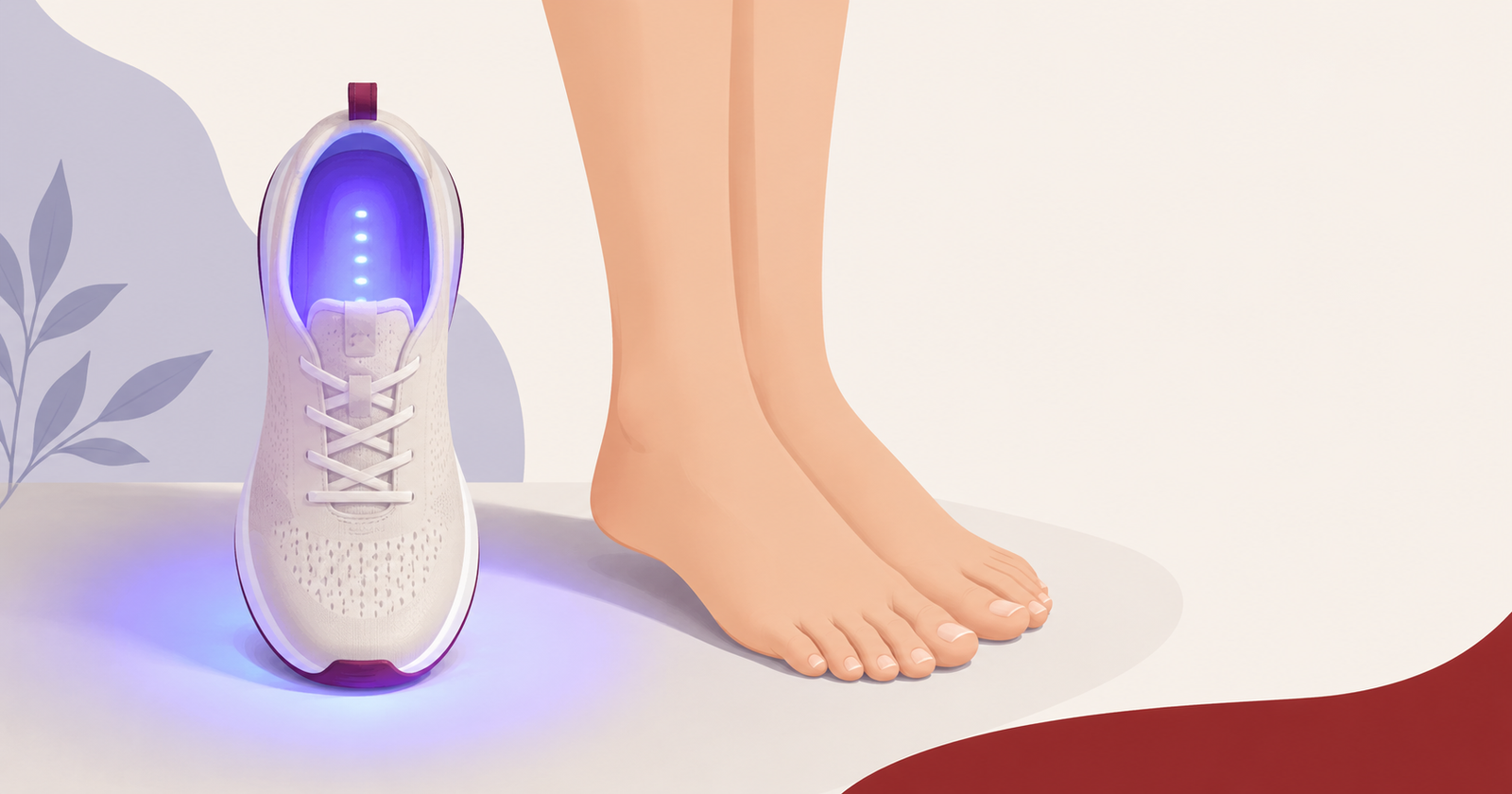
UV shoe sanitizers are the devices people most often end up buying, and they’re worth understanding correctly, because they aren’t aimed at your nail at all. They sit inside a shoe and target the fungus living in the shoe itself.
That’s a real issue — reinfection from footwear is a genuine reason nail fungus comes back after it seems to clear. So a shoe sanitizer is best thought of as one hygiene measure among several, alongside rotating your shoes so they dry out, changing socks, and drying thoroughly between the toes. It is not a treatment for an infected nail, and buying one instead of addressing the nail leaves the actual problem in place. Our guide on how to prevent toenail fungus covers the rest of that routine, and salting your shoes is a cheaper way to keep them drier.
We don’t offer laser nail treatment at our practice, but searches for UV and for laser get mixed together constantly, so it’s worth explaining the difference. Most laser devices used for nail fungus work in the infrared range and act mainly through heat (some newer ones are low-level, non-thermal lasers at visible wavelengths) — either way, not through UVC’s DNA-damaging effect. Some have FDA clearance, and it’s worth knowing exactly what that clearance says: it is generally for a temporary increase in clear nail — not a cure, and not a guarantee the fungus is gone. Results vary, treatment is often not covered by insurance, and recurrence is common without addressing footwear and the underlying causes.
We’re describing it because people ask, and because what that FDA clearance actually covers is often misunderstood.
The unglamorous answer is that it starts with confirming what you’re dealing with. Something like 40 to 50% of thickened, discolored nails turn out not to be fungus — trauma, psoriasis, and other conditions look similar, and treating the wrong thing for a year is a common and frustrating outcome. A nail sample settles it.
From there, care usually combines a prescribed topical or oral medication, thinning or debriding the nail so treatment can reach the infection, and the footwear and hygiene measures above so you aren’t reinfecting yourself. It takes months either way — a toenail grows roughly a millimeter a month, so a big toenail can take 12 to 18 months to fully replace itself. Even successful treatment shows as new clear nail growing out from the base rather than the damaged part improving. Our toenail fungus treatment page explains how we approach it.
If you have diabetes, neuropathy, or poor circulation, don’t self-treat a nail problem at all — including with any device. Reduced sensation can hide a problem that’s developing, and a small injury on an at-risk foot can become serious quickly. Have it examined instead.
For everyone else, it’s worth seeing a foot doctor in Long Beach if the nail is painful, if it’s spreading to other nails, if the skin around it is red or breaking down, or if you’ve been trying home approaches for several months without the nail changing. The American College of Foot and Ankle Surgeons has a plain-language overview of nail fungus if you’d like more background first.
A thick, discolored, or loosening toenail isn’t always fungus — many abnormal-looking nails turn out to be an injury, psoriasis, or another condition. The first step is an exam, often with a nail culture, to find out what’s going on. If it is fungal, our 6-Month Fungal Toenail Program builds on that testing with a structured plan that can include prescription antifungal options, in-office nail care, and prevention steps. Whether it fits you depends on your exam. You can also read about toenail fungus treatment in Long Beach.
UVC light damages fungal cells in laboratory conditions, but that doesn’t mean a UV device clears an infected toenail — the nail plate blocks the light, and the fungus lives in and under it. UV has a role in footwear hygiene at most; it is not a treatment for the nail, and it should never be used on skin.
There isn’t one, in the sense the question implies — no UV device has been shown to clear a nail infection, because the nail plate blocks the light from reaching the fungus underneath. UV shoe sanitizers are a different product that targets fungus in footwear, not in the nail. Never expose bare skin to a UVC lamp and never look at one; UVC can cause corneal injury and skin burns. If a nail is thickened or discolored, have it evaluated — a large share of such nails turn out not to be fungus at all.
No. Never expose bare skin to a UVC lamp and never look at one. UVC can cause corneal injury and skin burns, and some UVC lamps also emit UVB, the band linked to skin cancer. The safer home devices are built to keep the light enclosed; the FDA has warned that some handheld UV wands emit far above safe limits. If you have diabetes, neuropathy, or poor circulation, don’t use any device on your feet — have the nail examined instead.
They target fungus in the shoe, not in your nail. Reinfection from footwear is a real reason nail fungus returns, so they can be one part of a hygiene routine — but they don’t treat an existing nail infection. Keep the light enclosed inside the shoe; no UV device should be pointed at bare skin.
No. Most laser devices for nails work in the infrared range and act through heat, and some newer ones are low-level lasers at visible wavelengths — neither works the way germicidal UVC does. FDA clearance for these devices is typically for a temporary increase in clear nail rather than a cure. We don’t offer laser nail treatment at our office.
Be educated, get empowered, and encourage others today!
This article is for general information only and is not medical advice, diagnosis, or treatment. It is not a recommendation to use any device, and individual results vary. Ultraviolet devices are not for use on skin or eyes. Thickened or discolored nails have several possible causes, and only an in-person evaluation by a licensed podiatrist can determine what you have and what is appropriate for you. If you have diabetes, reduced sensation, poor circulation, or a nail that is painful, bleeding, or accompanied by broken or reddened skin, seek care promptly. Reviewed by Dr. S Don Kim, DPM, FACFAS.