
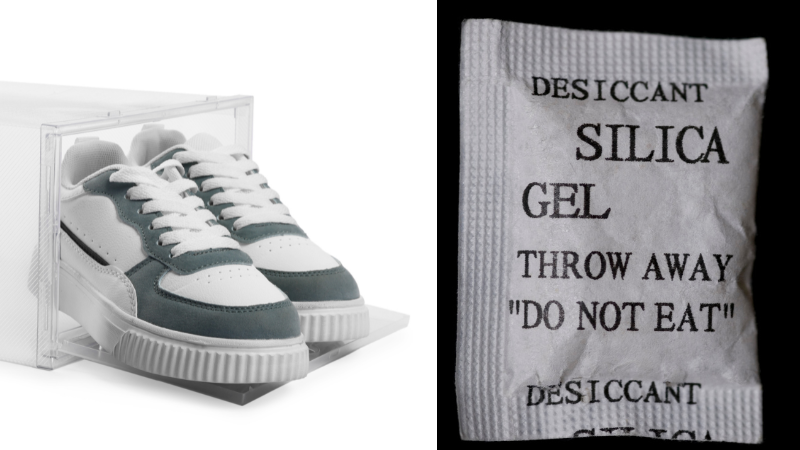
Nearly every new pair of shoes comes with a small paper packet inside, stamped with warnings and almost always thrown straight in the bin. It’s silica gel, and it’s there for one reason: to pull moisture out of the air inside the box. That’s genuinely useful for feet — but only for one specific job, and it’s worth being clear about what that job is and isn’t.
Silica gel is a desiccant — a material with an enormous internal surface area that traps water vapor. It isn’t a chemical treatment and it doesn’t kill anything. It simply lowers the humidity in a closed space, which is why manufacturers put it in shoe boxes to stop mildew and leather damage during shipping and storage.
That single property is why it matters for foot health. Feet have a very high density of sweat glands, and closed shoes trap that moisture. Damp, warm, dark conditions are what fungi and odor-causing bacteria prefer — so a shoe that dries out between wears is a less hospitable place for them than one that never does.
What it doesn’t do is treat anything. A desiccant addresses one contributing condition. It won’t clear an existing toenail fungus, it won’t cure athlete’s foot, and it won’t fix odor that’s coming from a skin infection rather than from damp shoes.
Within limits. Silica gel saturates rather than being used up, but capacity falls off after several cycles, so packets don’t revive forever. In practice, bulk desiccant packs cost very little, and replacing a saturated packet is simpler and safer than trying to recharge one at home.
Don’t microwave them. Microwaves heat unevenly, sealed sachets can build up steam pressure, and many packet wrappers aren’t microwave-safe — scorched and burst packets are the common results. Throw out any packet that has split or whose beads have gone crumbly.
Those packets say DO NOT EAT, and the warning matters most around small children and pets. If a child or pet swallows a packet or its beads, call Poison Control or your veterinarian right away rather than waiting to see what happens — in the United States, Poison Control is 1-800-222-1222 (free, 24/7). For a pet, call your veterinarian or the ASPCA Animal Poison Control Center at (888) 426-4435 — a consultation fee may apply.
Don’t try to judge it yourself. The packet and beads are a choking hazard, and a whole packet can in rare cases cause a blockage in the digestive tract. More importantly, not every “DO NOT EAT” packet is silica gel — calcium oxide (quicklime) desiccants are also used in shoe and leather packaging, and those are caustic. If a packet is swallowed and you can’t identify which type it was, say so when you call. Colored indicating beads (blue or orange) contain a dye that Poison Control considers low-risk in the amounts a packet holds, but it’s worth mentioning on the phone too.
The safest habit is simple — take the packets out of new shoes and put them somewhere children and pets can’t reach, or throw them away.
For context rather than reassurance: plain silica gel is chemically inert and, on its own, is not the poisoning risk many people assume. But that call is Poison Control’s to make once they know what was swallowed, not one to make at home.
Silica gel is a small part of a bigger picture, and the rest of it matters more:
If odor persists after the shoes are genuinely dry, or comes with itching, peeling skin between the toes, or thick discolored nails, the problem is on your foot rather than in your footwear — and a desiccant won’t touch it. That’s worth an exam rather than another product.
If you have diabetes, neuropathy, or poor circulation, keeping footwear dry matters more for you than for most people — but it does not replace checking your feet daily and having any skin or nail change looked at promptly. Reduced sensation means a problem can develop without pain to warn you.
For persistent problems, our toenail fungus treatment in Long Beach page explains how we approach it, and the American College of Foot and Ankle Surgeons has background on smelly feet.
It absorbs moisture from the air inside the shoe, nothing more. That’s useful because damp shoes are friendlier to odor-causing bacteria and fungi, but the packet doesn’t kill anything and doesn’t treat an existing infection.
Put the packets in after you take the shoes off, use several rather than one, loosen the laces so air can move, and leave them overnight. Take them out before wearing the shoes — check inside with your hand, not just a glance, especially if you have diabetes or reduced sensation. Rotating between two pairs so each dries fully does more than the packets alone.
Within limits, but never microwave one — microwaves heat unevenly, sealed sachets can build up steam pressure, and many wrappers aren’t microwave-safe. Silica gel saturates rather than being used up, but capacity falls off after several cycles, so packets don’t revive forever. In practice, replacing a saturated packet is cheaper and safer than recharging one at home. Throw out any packet that has split or whose beads have gone crumbly.
For adults, handling the packets isn’t a concern; the risk is to small children and pets. If a child swallows a packet or its beads, call Poison Control at 1-800-222-1222 (US) right away rather than waiting to see what happens; for a pet, call your veterinarian or the ASPCA Animal Poison Control Center at (888) 426-4435. The packet and beads are a choking hazard, a whole packet can in rare cases cause a blockage, and not every “DO NOT EAT” packet is silica gel — calcium oxide desiccants are also used in shoe packaging and those are caustic. Keep packets out of reach or throw them away. Plain silica gel itself is not poisonous, but that judgement belongs to Poison Control once they know what was swallowed.
No. It only removes moisture from the shoe. Dry shoes are part of a sensible foot-hygiene routine, but a desiccant does not kill bacteria or fungus and does not treat athlete’s foot or a fungal nail. If the smell persists once shoes are dry, or you have itching, peeling skin, or discolored nails, the problem is on your foot and should be examined by a podiatrist.
Be educated, get empowered, and encourage others today!
This article is for general information only and is not medical advice, diagnosis, or treatment. Individual results vary. Silica gel packets are not for ingestion — keep them away from children and pets, and contact Poison Control (1-800-222-1222 in the US) or your veterinarian immediately if a packet is swallowed. Persistent foot odor, itching, peeling skin, or nail changes can have several causes, and only an in-person evaluation by a licensed podiatrist can determine what you have and what is appropriate for you. If you have diabetes, reduced sensation, or poor circulation, have any new foot or nail change examined promptly. Reviewed by Dr. S Don Kim, DPM, FACFAS.