
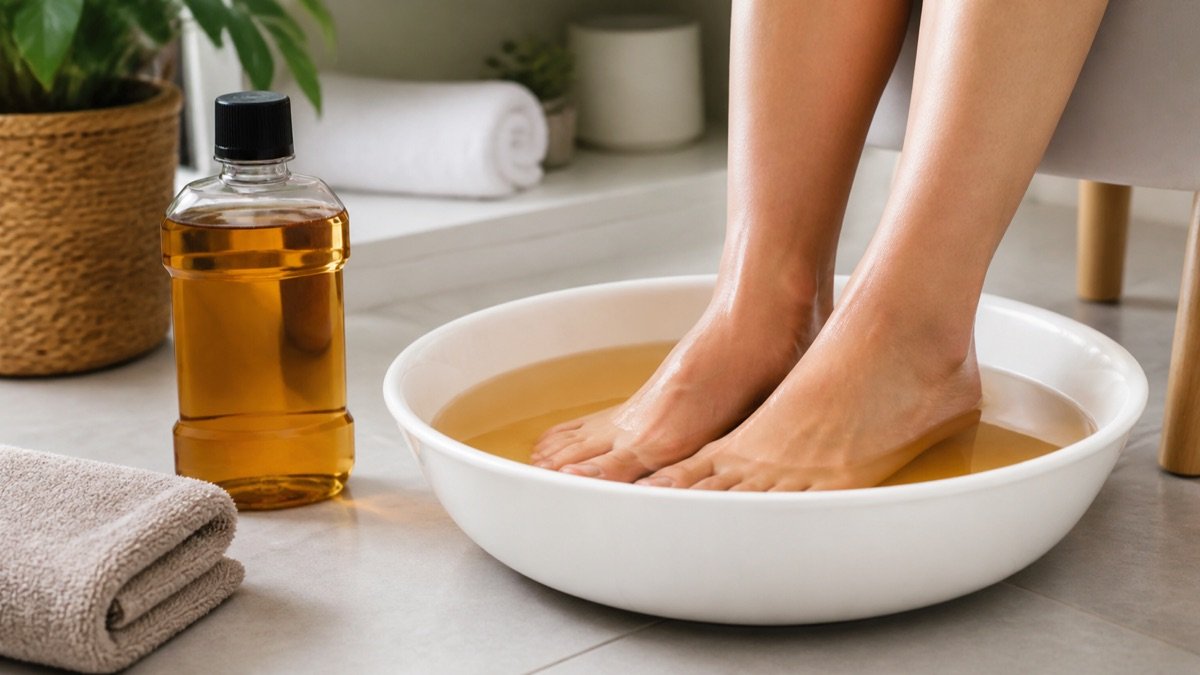
Soaking your feet in a basin of amber mouthwash — Listerine for toenail fungus — is one of the internet’s most popular home remedies, and it’s fair to wonder whether it actually does anything. The honest answer: Listerine’s antiseptic oils have mild antifungal activity in the laboratory, but there is no clinical proof that it clears an established toenail infection, and it can’t reliably reach the fungus living under and inside the nail. A soak may freshen the skin, and at most could help a mild, surface-level case where an antifungal cream would still do more — but a thick, discolored, or spreading nail needs a real diagnosis, because only an in-person exam can confirm what you’re actually dealing with.
Listerine was designed as an antiseptic mouth rinse, and that’s exactly why the foot-soak idea caught on. It contains a blend of antiseptic essential oils — thymol, eucalyptol, menthol, and methyl salicylate — in an alcohol base. Those ingredients can kill or slow certain germs on a surface, so the reasoning goes that a foot bath might do the same to the fungus on your feet. It’s cheap, it’s already in the cabinet, and the tingling feels like it’s “working.” That intuition isn’t crazy — but feeling something and clearing an infection are two very different things.
Here’s the important distinction. In a lab, the essential oils in Listerine — thymol especially — do show mild antifungal activity against the dermatophytes that cause most athlete’s foot. That’s real, but it’s a petri-dish result, not a cure. No randomized clinical trial has shown that a Listerine soak actually clears toenail fungus in people.
The bigger problem is physical. Toenail fungus (doctors call it onychomycosis) lives in and beneath a hard, dense nail plate that is built to keep things out. A liquid you soak your foot in mostly sits on the surface and struggles to penetrate to where the fungus actually is. That’s the same reason many over-the-counter treatments underperform on nails — and precisely why the treatments proven to work are prescription-strength: specialized topical antifungals designed to soak into the nail, or oral antifungal pills that reach the nail bed from the inside. You can read a plain-English overview from the American College of Foot and Ankle Surgeons on nail fungus.
| A Listerine soak might help with | What it can’t reliably do |
|---|---|
| Freshening odor and rinsing the skin | Penetrate the nail plate to reach the fungus |
| A mild, early, surface-level case on the skin | Clear an established, thickened nail infection |
| Feeling clean between proper treatments | Replace a prescription topical or oral antifungal |
| Guarantee any result — it’s unproven for nails |
In short: it is closer to a hygiene habit than a treatment. If your problem is really athlete’s foot on the skin rather than the nail, a soak has a better shot, because the fungus there is more reachable — but even then, an actual antifungal cream is the more dependable choice.
A common variation adds white vinegar to the Listerine. The thinking is that vinegar’s acidity makes the environment less friendly to fungus, and, like the mouthwash, vinegar does show some mild antifungal activity in lab conditions. But it runs into the exact same wall: the same lack of clinical proof and the same inability to get through the nail. Combining two unproven soaks doesn’t add up to a proven one. If you’re curious about vinegar specifically, we cover it in our post on vinegar foot soaks. Other kitchen-cabinet remedies people ask about — like coconut oil and Vicks VapoRub — have similar limits.
Before you soak, know when not to. If you have diabetes, neuropathy (reduced feeling in your feet), or poor circulation, talk to a podiatrist first — reduced sensation means you may not feel water that’s too hot or skin that’s becoming irritated, and a small problem can quietly turn into a serious one. For anyone, keep it sensible:
Fungal nails are stubborn, and the treatments that work are the ones aimed at the right target. Depending on how much of the nail is involved, a podiatrist may recommend a prescription topical antifungal formulated to penetrate the nail, an oral antifungal that treats it from the inside, in-office thinning or debridement of the nail, or a combination. Just as important, an exam first confirms the diagnosis — many thick or discolored nails are not actually fungal (an old injury, psoriasis, or another issue can look identical), so treating for fungus without checking can waste months. You can also lower your odds of a repeat with the steps in our guide to preventing toenail fungus.
See a podiatrist if a nail is thickening, changing color, lifting, or spreading — and sooner if you have diabetes or circulation problems. A soak is low-stakes, but weeks spent hoping it works are weeks the infection can spread to other nails. If you’d like a clear answer on what your nail actually is and what will realistically clear it, our team offers toenail fungus treatment in Long Beach. You can also meet our doctors whenever you’re ready.
A thick, discolored, or loosening toenail isn’t always fungus — many abnormal-looking nails turn out to be an injury, psoriasis, or another condition. The first step is an exam, often with a nail culture, to find out what’s going on. If it is fungal, our 6-Month Fungal Toenail Program builds on that testing with a structured plan that can include prescription antifungal options, in-office nail care, and prevention steps. Whether it fits you depends on your exam. You can also read about toenail fungus treatment in Long Beach.
Don’t count on it to clear a nail infection. Listerine’s antiseptic oils show only mild antifungal activity in the lab, there’s no clinical proof it cures toenail fungus, and a soak can’t reliably penetrate the nail. See a podiatrist for a nail that is thick, discolored, or spreading.
It has the same limits, so don’t rely on it for a nail infection. Both Listerine and vinegar show mild antifungal activity in lab tests, but neither is proven to cure toenail fungus and neither gets through the nail plate. Combining two unproven soaks doesn’t make a proven treatment.
There is no proven protocol, because it isn’t an established treatment. If you try it, dilute it, keep sessions short, avoid broken skin, and dry thoroughly afterward. If you have diabetes or neuropathy, ask a podiatrist before soaking at all.
Check with a podiatrist first if you have diabetes, neuropathy, or poor circulation, because reduced feeling can hide burns or irritation. For most others an occasional diluted soak is low-risk on intact skin, but stop if the skin becomes red or irritated.
Proven options are prescription-strength: a topical antifungal made to penetrate the nail, an oral antifungal, or in-office care from a podiatrist, often after confirming the nail is truly fungal. Over-the-counter soaks rarely clear an established infection on their own.