
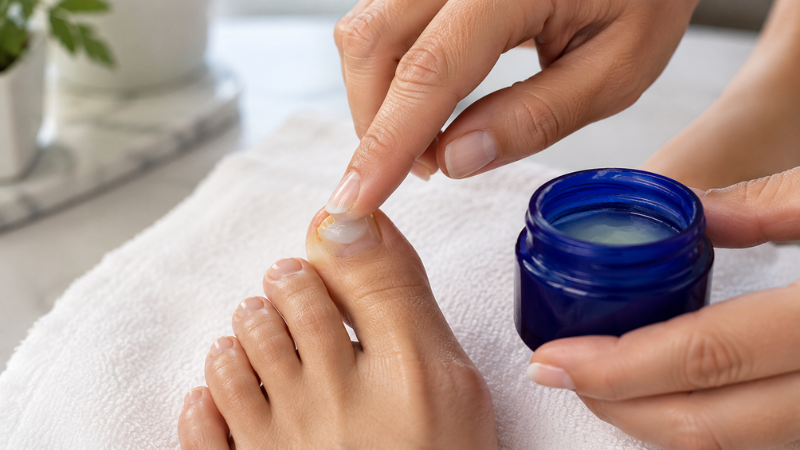
Search for home remedies for fungal nails and Vicks VapoRub for toenail fungus comes up again and again. It sounds like an internet myth — a chest rub for a nail infection? — but unlike most home remedies, this one has actually been put through a small clinical study. The short answer: in the only clinical study to date, daily Vicks VapoRub improved the appearance of fungal toenails in 15 of 18 people (83%), but fully cured the infection in only about 1 in 4 — after 48 weeks of use. Here is what that means in practice, how to try it safely, and when it makes more sense to have a podiatrist treat the nail properly.
Vicks VapoRub contains camphor, menthol, and eucalyptus oil. In laboratory studies cited in the clinical research below, these ingredients have shown activity against some of the fungi that cause nail infections. That, plus the fact that a jar costs a few dollars and sits in most medicine cabinets, explains why it became one of the most popular do-it-yourself approaches to fungal nails.
At our holistic practice, we like remedies that are gentle, inexpensive, and low-risk — as long as expectations are honest. So let’s look at the actual data.
A pilot study published in the Journal of the American Board of Family Medicine (2011) followed 18 people who applied Vicks VapoRub to fungal toenails for 48 weeks. The results:
83%
showed improvement
(15 of 18 nails)
27.8%
fully cured at 48 weeks
(5 of 18)
55.6%
partial clearance
(10 of 18)
16.7%
no change
(3 of 18)
The honest takeaway: most nails looked better, but only about 1 in 4 infections cleared completely — and it took nearly a year. This was also a small study with no comparison group (study summary on PubMed), so the results are encouraging rather than conclusive. Vicks may help mild, early infections, but it is not a guaranteed fix.
First, a caution: if you have diabetes, neuropathy, or poor circulation, skip the home trial — trimming and filing nails yourself carries real risk. See the “When to See a Podiatrist” section below instead.
Stop using it if the skin becomes red, itchy, or irritated.
An ointment sitting on top of the nail has a hard time reaching fungus living under it, in the nail bed. That is why thick, crumbly, long-standing infections rarely clear with any rub-on home remedy. Fungal nails also spread — to other toes, to the surrounding skin (athlete’s foot), and to other people in the household. The longer an infection sits, the harder it is to treat, whatever method you choose. The American College of Foot and Ankle Surgeons has a good overview of how fungal nail infections behave and progress.
Over-the-counter antifungal creams share the same basic limitation as Vicks: they sit on the surface of a nail that the fungus lives underneath. Prescription options go further. Oral antifungal medication reaches the nail bed through the bloodstream and has the highest cure rates in clinical trials — though it isn’t right for everyone and requires medical supervision. Prescription topical treatments are formulated to penetrate the nail far better than anything from the drugstore shelf. And in-office care — trimming and thinning the nail, treating the surrounding skin, correcting shoe and moisture habits — can help every one of these options work better. The right choice depends on how deep and how old the infection is, which is exactly what a podiatrist can determine in one visit. Another popular home remedy worth an honest look: does Epsom salt help toenail fungus? (Short version — it soothes, but it won’t clear the infection.)
| Treatment | How it reaches the fungus | Best suited for | Keep in mind |
|---|---|---|---|
| Vicks VapoRub / OTC creams | Sits on the nail surface | Mild, early infections at the nail edge | Slow; complete cure is the exception, not the rule |
| Prescription topicals | Formulated to penetrate the nail | Mild-to-moderate infections | Requires a prescription; months of daily use |
| Oral antifungal medication | Through the bloodstream to the nail bed | Established or multiple-nail infections | Needs medical supervision; not right for everyone |
| Podiatrist-supervised care | Nail trimming/thinning + targeted treatment + habit changes | Thick, stubborn, or recurring infections | The most thorough route — starts with one diagnostic visit |
Whatever you put on the nail, the environment around it matters just as much. Fungus thrives in dark, damp shoes — so give your feet light and air. We’ve written about several complementary approaches: why fungal nails need sunlight, using coconut oil on fungal nails, and sanitizing your shoes so you don’t re-infect yourself with every step. These habits cost almost nothing and can help any treatment — home remedy or medical — work better. We put the full checklist in one place: how to prevent toenail fungus.
Make an appointment rather than experimenting at home if:
Persistent fungal nails often respond better to a structured plan that treats the nail, the nail bed, and the habits around them together. That is exactly what our 6-Month Fungal Toenail Transformation Program is built for. If you’re not sure how advanced your infection is, our podiatrists can tell you in one visit — and you’ll know whether a home remedy still has a realistic chance. Our toenail fungus treatment in Long Beach starts with confirming the diagnosis and covers the options that work when home remedies don’t.
A thick, discolored, or loosening toenail isn’t always fungus — many abnormal-looking nails turn out to be an injury, psoriasis, or another condition. The first step is an exam, often with a nail culture, to find out what’s going on. If it is fungal, our 6-Month Fungal Toenail Program builds on that testing with a structured plan that can include prescription antifungal options, in-office nail care, and prevention steps. Whether it fits you depends on your exam. You can also read about toenail fungus treatment in Long Beach.
In the published study, participants used it daily for 48 weeks. Visible improvement, when it happened, took months. If you see nothing after 3–4 months of consistent use, it’s unlikely to clear that nail on its own.
Sometimes, but not usually. In the study, about 28% of participants had a complete cure; most had partial improvement. Established or thick infections generally need professional treatment.
For most healthy adults, applying Vicks to the toenail is low-risk; stop if skin irritation develops. If you have diabetes, neuropathy, or circulation problems, see a podiatrist before trying any home remedy on your feet.