Burning Feet: What Causes That Hot, Stinging Feeling and When to See a Doctor
Dr. S Don Kim
10/05/2026
You take your shoes off at the end of the day and your feet feel hot — not sore, not swollen, but burning, as if the soles were pressed against something warm. Later, in bed, it gets louder. Burning feet is a complaint we hear often, and it usually isn’t an injury at all. It’s a nerve signal. Here’s what causes that hot, stinging feeling, what tends to make it worse while you wait, and when it needs to be looked at quickly.
In short: burning feet are most often a sign of irritated or damaged nerves (peripheral neuropathy), and diabetes is the leading cause of that nerve damage in the United States — up to half of people with diabetes have peripheral neuropathy. Less often the cause is local — a pinched nerve, a forefoot problem, or a skin infection. Because the nerves that carry the burning also carry protective sensation, the safest first step is an exam, not a home remedy.
When Burning Feet Need Urgent Care
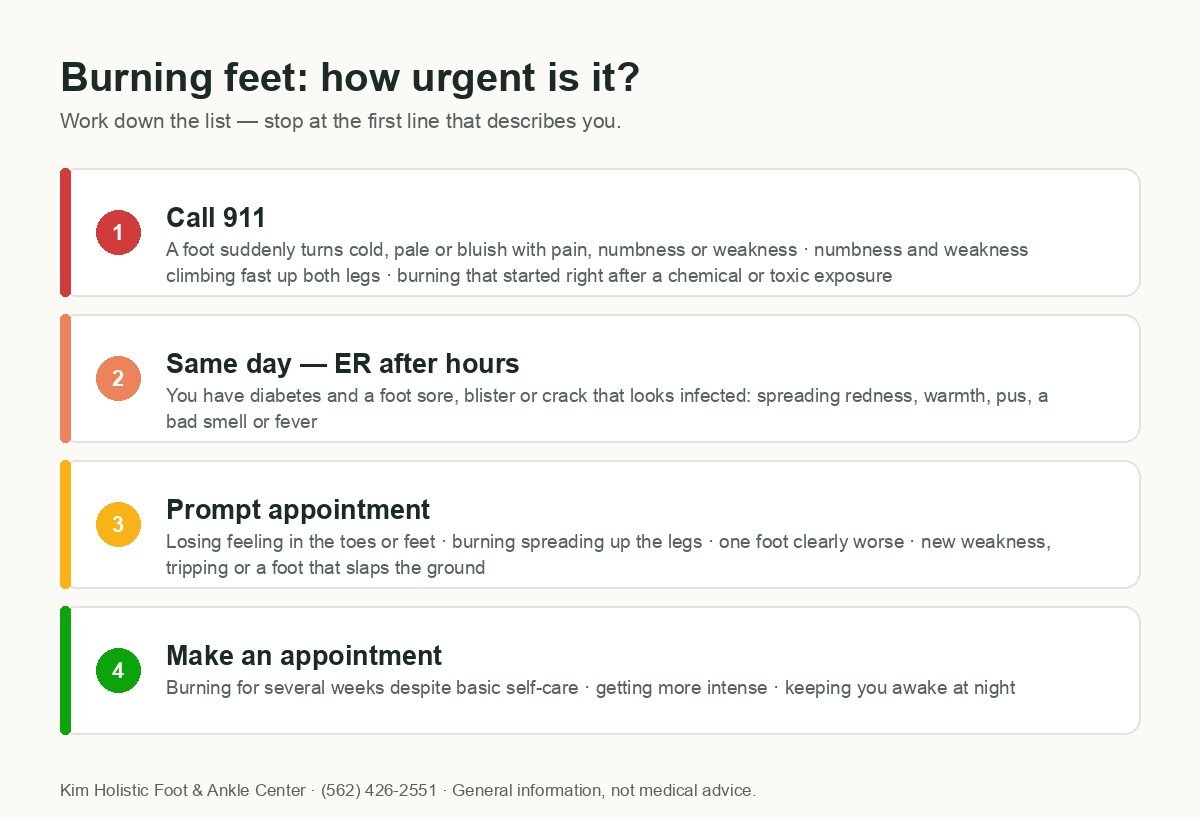
Most burning feet build up slowly over months. These are the exceptions, in order of urgency:
Call 911 if a foot suddenly turns cold, pale, or bluish along with pain, numbness, or weakness, or if numbness and weakness are climbing quickly from both feet up your legs. Both can mean an emergency — a blocked artery in the first case, a nerve emergency in the second. Call 911 or go to an emergency room now, too, if the burning came on suddenly after a chemical, solvent, pesticide, or other toxic exposure; sudden burning after an exposure can mean more than a foot problem.
Same day — or an emergency room after hours — if you have diabetes and an open sore, blister, or crack on your foot that looks infected: spreading redness, warmth, pus, a bad smell, or fever.
A prompt appointment if you’re losing feeling in your toes or feet, if the burning is spreading up into your legs, if one foot is clearly worse than the other, or if you’re noticing new weakness, tripping, or a foot that slaps the ground when you walk.
Make an appointment if the burning has gone on for several weeks despite basic self-care, is getting more intense, or is keeping you awake.
When burning feet need urgent care, from most to least urgent.
What Causes Burning Feet?
Clinicians sometimes call the symptom itself burning feet syndrome (Grierson-Gopalan syndrome). That name describes the sensation; it isn’t a diagnosis of what is driving it, which is what the visit is for.
Think of the nerves in your feet as wiring that reports temperature, pressure, and pain. When that wiring is irritated or damaged, it can fire on its own, and the brain reads the signal as heat. That’s why the skin can feel like it’s burning while it’s cool to the touch.
Nerve-related causes (the common group)
Diabetes. Years of elevated blood sugar damage the small nerves that reach the feet first, and diabetes is the leading cause of peripheral neuropathy in the United States. Burning, tingling, and numbness in both feet, worse at night, is the classic pattern, and it is sometimes what sends someone for the blood test that finds the diabetes.
Vitamin deficiencies. Mayo Clinic lists vitamin deficiency anemia among the causes; low vitamin B12 in particular is associated with nerve damage, and a blood test is how your doctor can check it.
Too much vitamin B6. This one surprises people: high-dose B6 supplements taken for a year or longer can themselves cause severe nerve damage. More on this below.
Heavy alcohol use, which damages nerves directly and through poor nutrition.
Thyroid and kidney disease. An underactive thyroid and chronic kidney disease both show up on the list of causes.
Chemotherapy and some medications. Several cancer drugs and certain other medicines can irritate the small nerves. Long-term metformin can also lower vitamin B12, which is one reason B12 is checked when someone with diabetes develops burning feet. Never stop a prescription on your own — ask the prescribing doctor.
Erythromelalgia, a rarer condition in which the feet turn visibly red and hot in episodes, often set off by warmth or exercise. The visible color change is what sets it apart.
Other medical causes, including HIV infection, inherited nerve conditions such as Charcot-Marie-Tooth disease, and complex regional pain syndrome after an injury.
Local foot causes (one foot, or one spot)
Tarsal tunnel syndrome, where a nerve is squeezed as it passes behind the inner ankle bone. The burning often runs into the arch and sole of one foot.
A pinched nerve between the toes. Burning concentrated between the third and fourth toes, often with a feeling of a pebble underfoot, points toward Morton’s neuroma.
Forefoot overload. Burning under the ball of the foot after long days, running, or thin-soled shoes is a different problem — see our guide to ball of foot pain.
Athlete’s foot. A fungal skin infection can burn, itch, and sting, usually with scaling, peeling, or cracked skin you can see, often between the toes.
Shoes and socks. Tight toe boxes, heat, and damp socks irritate skin and nerves. This rarely explains burning that’s present day after day.
Why Burning Soles of Feet Feel Worse at Night
Nerve-related burning is often worse at night — it’s one of the most consistent things people describe, and it’s how the pattern is described in the diabetes literature too. Why isn’t fully settled. Nerve pain can come from pain receptors firing on their own with no trigger, and from changes in the way the spinal cord processes signals, which is why even the touch of a bedsheet can hurt. Lying still in a quiet room, without the day’s movement and distraction, likely makes that background signal easier to notice, and warm bedding may add to it. If the burning regularly costs you sleep, that’s a reason to be seen rather than a reason to try a stronger remedy.
Burning Sensation in the Feet: What Home Steps Can and Can’t Do
None of this treats the cause, and none of it replaces the exam described below. These are the steps that are safe to take in the meantime, including for feet that have lost some feeling:
Rinse in warm — not hot, not cold — water. Dry thoroughly, including between the toes. Test the water with your hand or elbow first. Skip ice and cold packs on skin that is numb, since you may not feel a cold injury either.
Move the heat away. A fan in the bedroom, lighter bedding, or keeping the feet out from under heavy covers is a low-risk thing to try at night, and some people find the burning easier to ignore when the feet are cooler.
Change what the feet sit in all day. Moisture-wicking socks, a wider toe box, and a well-cushioned shoe reduce the heat, damp, and pressure that irritate skin and nerves.
Don’t treat a skin problem as nerve pain, or the reverse. Burning that comes with scaling, peeling, or cracked skin between the toes can be a skin infection rather than a nerve problem, and the two are treated differently — a podiatrist can tell them apart. Cracked or open skin between the toes needs to be looked at promptly, and same day if you have diabetes.
Ask before you add anything. That includes supplements and topicals, including ones sold for nerve pain such as capsaicin cream — bring the label to your appointment or the prescribing doctor, especially if you have diabetes, numbness, or any break in the skin.
What Can Make Burning Feet Worse While You Wait
Two things we see often, both well-intended:
Heat and soaking. Hot water, heating pads, and hot-water bottles feel like the obvious answer to a nerve that’s misreporting temperature — but a foot with nerve damage may not register a burn until the skin is already injured. If you have diabetes, numbness, or circulation problems, skip them entirely. The CDC’s guidance for diabetes is to wash feet in warm (not hot) water, and not to soak them. Check any water with your hand or elbow first; your feet may not be able to tell you.
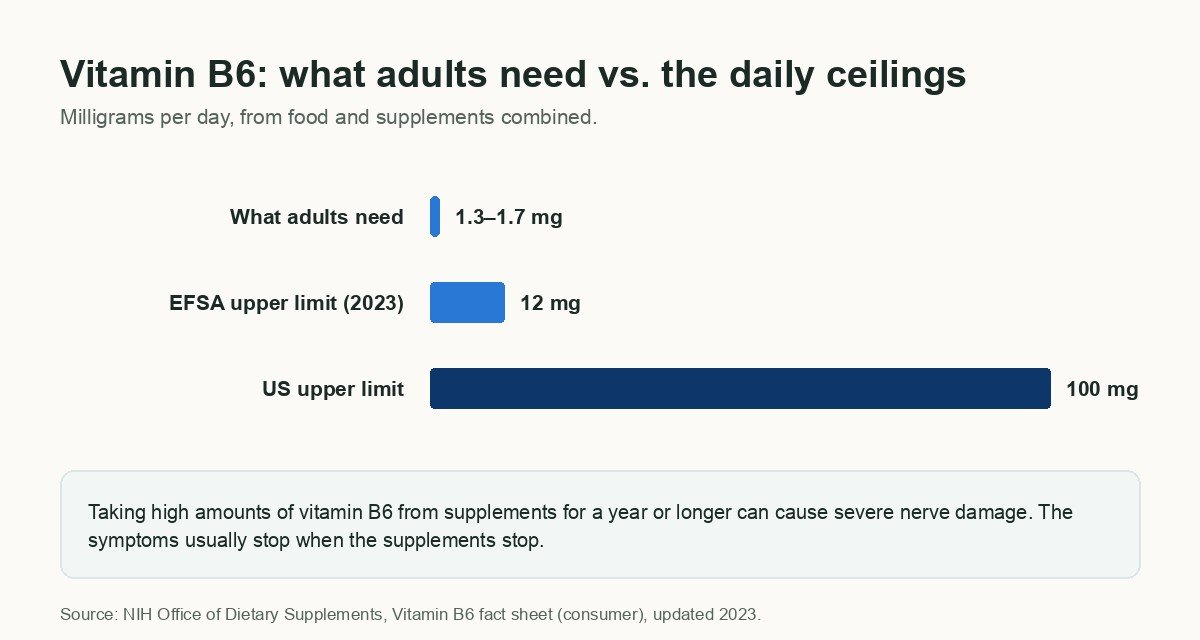
High-dose vitamin B6. Shelves are full of B-complex and “nerve support” formulas, and B6 doses well above anything you’d eat in a day are common in them. Taking high amounts of vitamin B6 from supplements for a year or longer can cause severe nerve damage — the symptoms usually ease after stopping, but it can take time. The adult upper limit is 100 mg a day from all sources combined, and the European Food Safety Authority set a far lower limit of 12 mg a day in 2023; the amount adults actually need is only about 1.3 to 1.7 mg. Before you add a supplement for burning feet, read the B6 line on the label and bring it to your appointment. See the NIH Office of Dietary Supplements fact sheet on vitamin B6 for the full numbers.
Adults need 1.3–1.7 mg of vitamin B6 a day; the US upper limit is 100 mg. Source: NIH Office of Dietary Supplements.
One more: if you have diabetes, or your feet are numb in places, look at them every day — tops, soles, and between the toes, with a mirror if you can’t see the bottom. A burn, blister, or cut you can’t feel is how a small problem becomes a serious one.
How a Podiatrist Finds the Cause
The job at the visit is to separate a nerve problem affecting both feet from a local one, and to find anything treatable behind it. That usually involves asking when the burning started and how it has spread, testing sensation on the soles, checking reflexes and strength, and examining the pulses, skin temperature, and skin itself. Circulation can be checked in the office with peripheral vascular analysis; ultrasound can show a thickened or compressed nerve, and X-ray can rule out a bone or joint problem under the ball of the foot. Blood work for blood sugar, B12, thyroid, and kidney function is usually coordinated with your primary care doctor, and nerve testing — including testing for small-fiber neuropathy, the term you may hear if you’re referred — can be arranged when the picture isn’t clear.
What comes next depends on what’s found. A pinched nerve may respond to a change in shoe, padding, or an orthotic that takes pressure off the nerve; a skin infection is treated as an infection; neuropathy from diabetes is managed alongside blood sugar control, with daily foot checks and regular foot exams to protect the skin. Several medications can reduce nerve pain, and your doctor can talk through whether one fits you. No approach works for everyone, and the honest answer at a first visit is usually a plan with follow-up, not a single fix.
When to See a Podiatrist in Long Beach
Burning that has lasted several weeks, is getting stronger, is spreading upward, or comes with numbness deserves an exam — and if you have diabetes, so does any new sensation change at all. Our team can check the nerves, circulation, and structure of your feet, treat what’s treatable in the foot, and coordinate the rest with your other doctors. If diabetes is part of your picture, see our page on diabetic foot care in Long Beach, or call (562) 426-2551. If your feet also run cold or change color, our guide to cold feet covers that side of it.
What causes burning feet?
Burning feet are most often a sign of nerve damage (peripheral neuropathy), and diabetes is the leading cause of that nerve damage in the United States, so ask your doctor about a blood sugar test if you haven’t had one recently. Other causes include low vitamin B12, heavy alcohol use, thyroid and kidney disease, chemotherapy, a pinched nerve such as tarsal tunnel syndrome or Morton’s neuroma, and athlete’s foot.
When is burning in the feet an emergency?
Call 911 if a foot suddenly turns cold, pale, or bluish with pain, numbness, or weakness, or if numbness and weakness are climbing quickly up both legs. Go to an emergency room now if the burning came on suddenly after a chemical, solvent, or other toxic exposure. Get same-day care, or an emergency room after hours, if you have diabetes and a foot wound that looks infected — spreading redness, pus, a bad smell, or fever.
Which vitamin deficiency causes burning feet?
Low vitamin B12 is the deficiency most often linked to burning feet, but don’t start a high-dose B6 or “nerve support” B-complex supplement to treat it — high-dose vitamin B6 taken for a year or longer can itself cause severe nerve damage. A blood test is how your doctor can check B12, so ask before starting anything. The adult upper limit for B6 is 100 mg a day from all sources, while adults need only about 1.3 to 1.7 mg.
Why are my feet burning at night?
If your feet burn at night, avoid heating pads, hot-water bottles, and hot soaks — with diabetes or any numbness you may not feel a burn until the skin is injured — and make an appointment if it’s costing you sleep. Nerve-related burning is often worse at night, partly because damaged nerves can fire on their own and partly because lying still in a quiet room makes that signal easier to notice.
What blood test is done for burning feet?
Before starting any supplement, ask for testing first — blood work for burning feet usually means fasting glucose or A1c for diabetes, vitamin B12, thyroid (TSH), and kidney function, generally ordered by your primary care doctor. Nerve testing is added when the pattern isn’t clear. What the results show changes what you need, which is why guessing with a high-dose supplement can backfire.
Medical Disclaimer: This article is for general informational purposes only and is not a substitute for professional medical advice, diagnosis, or treatment. Individual results vary. Always consult a qualified podiatrist about your specific condition. To schedule an appointment at Kim Holistic Foot & Ankle Center in Long Beach, call (562) 426-2551.