
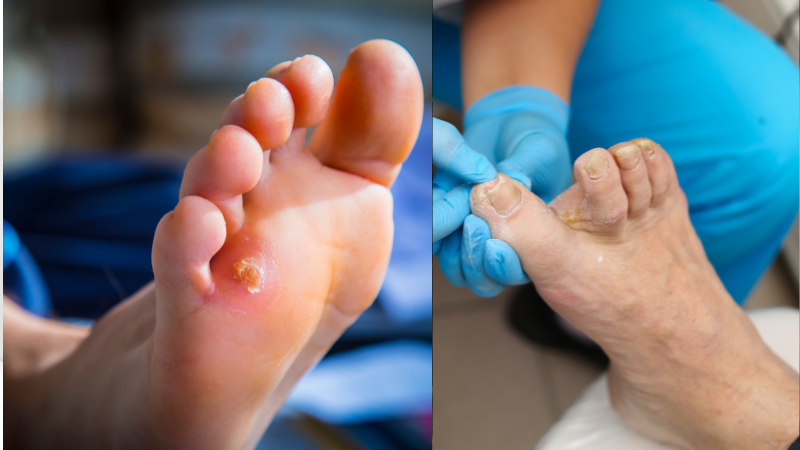
Kissing corns are the pair of tender spots that form where two toes press against each other — one on each toe, facing one another, which is where the name comes from. They’re most common between the fourth and fifth toes, and they behave differently from the hard corns people are used to seeing on the top of a toe.
If you have diabetes, neuropathy, or poor circulation, don’t treat a lesion between your toes at home — no blades, no medicated pads, no filing. Book an appointment instead. The reasoning is in the sections below, but the instruction doesn’t change.
A corn is thickened skin your body builds in response to repeated pressure. On the top of a toe, where air reaches it, that skin dries into a hard, sometimes yellowish plug. Between the toes it’s a different environment — warm, closed in, and damp with sweat — so the same thickened skin absorbs moisture and stays soft, pale, and rubbery. Clinicians call these soft corns, and that softness is why they can feel more like a raw, stinging spot than a hard lump.
It also matters practically: soft, macerated skin splits more easily than dry skin. A kissing corn that cracks opens a route for infection, which is the main reason these are worth dealing with rather than tolerating.
Skin doesn’t thicken without a reason. With kissing corns the pressure is almost always coming from one of these:
The space between the toes is a crowded diagnostic neighborhood, and this is worth knowing before you treat anything — though these are rough signs, not a diagnosis, and they overlap often enough that guessing is how people end up treating the wrong thing for months:
If you can’t tell which of these you’re looking at, that uncertainty is itself the reason to have it examined rather than to start treating it.
Don’t cut, shave, or dig at a corn, and we’d advise against medicated corn pads and liquids. Most of those work by applying salicylic acid, which can’t tell the difference between thickened skin and the healthy skin around it — in a damp, enclosed space like a toe web, that acid spreads and burns normal tissue. Chemical burns and open wounds from medicated corn plasters are a well-recognized complication, and NHS guidance warns that corn paints and plasters contain acids that can burn the skin.
If you have diabetes, neuropathy, or poor circulation, don’t self-treat a corn at all — no blades, no medicated pads, no filing. Reduced sensation means you may not feel damage as it happens, and a soft corn that breaks down on an at-risk foot can become a serious wound quickly. Have it looked at instead.
For most people, relief starts with taking the pressure off. If you have diabetes, neuropathy, or poor circulation, treat the list below as things to raise at an appointment rather than to try on your own:
Our corn and callus treatment in Long Beach page covers how we work through that, and the American College of Foot and Ankle Surgeons has general background on corns. If you have thickened skin elsewhere on the foot — not in the web space — our guide to marigold for warts and calluses looks at what home remedies can and can’t do.
Come in if the corn is painful enough to change how you walk, if it keeps returning after it clears, if the skin has split or is draining, if there’s redness spreading into the foot, or if you’re not certain it’s a corn in the first place. And if you have diabetes or reduced sensation, any new lesion between the toes is worth an appointment rather than a wait-and-see.
They’re a pair of corns that form directly opposite each other where two toes press together, most often between the fourth and fifth toes. Because the space between the toes stays damp, they usually stay soft and white rather than hard, which is why they’re also called soft corns.
First make sure it is a corn: if the area is itchy or flaking across the web space, it may be athlete’s foot instead, and the treatment is completely different. For a corn, start by taking the pressure off: shoes with a wider toe box, a soft toe spacer to keep the two surfaces apart, and keeping the web space dry. Don’t cut them or use medicated corn pads, which can burn healthy skin. If you have diabetes, neuropathy, or poor circulation, don’t try any of this at home — have the foot examined instead. Having the tissue pared down professionally often eases the pressure, and if a bone prominence or toe position is causing them, that is usually what determines whether they return.
No, but they’re easy to confuse, because both cause soft white skin between the toes. Athlete’s foot is a fungal infection and tends to itch, flake, and spread across the web space; a corn is thickened skin in one defined spot. If you’re unsure, that’s worth an exam — the treatments are completely different.
We’d advise against it. Most medicated pads use salicylic acid, which can’t distinguish thickened skin from healthy skin, and in the damp space between the toes it spreads easily and can cause a chemical burn or an open wound. If you have diabetes, neuropathy, or poor circulation, don’t use them at all.
Because the pressure that created them is usually still there. A prominent knuckle, a hammertoe, or a narrow toe box will rebuild the corn after it’s removed. Managing the skin helps in the short term; changing what’s pressing on it is what changes the pattern.
Be educated, get empowered, and encourage others today!
This article is for general information only and is not medical advice, diagnosis, or treatment. Individual results vary. Lesions between the toes have several possible causes, and only an in-person evaluation by a licensed podiatrist can determine what you have and what is appropriate for you. If you have diabetes, reduced sensation, or poor circulation, or if the skin is broken, draining, or surrounded by redness, seek care promptly rather than treating it at home. Reviewed by Dr. S Don Kim, DPM, FACFAS.