
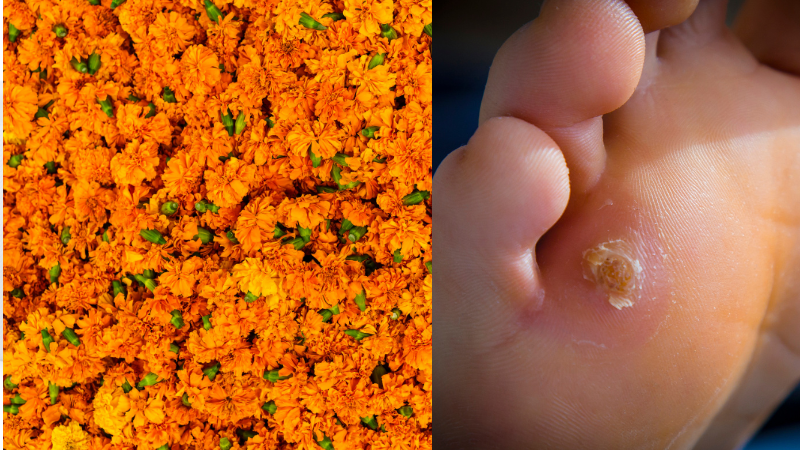
Marigold — the pot marigold, Calendula officinalis, not the ornamental garden variety — has a long history in skin care. It has been studied mainly for soothing irritated skin and supporting wound healing, though the evidence is limited and largely preliminary, and it’s a common ingredient in creams and salves. That’s why people ask about marigold for warts and calluses. It’s worth being clear up front about what it can and can’t do.
Calendula preparations are generally used to calm inflammation and keep skin comfortable and moisturized. Softer, better-hydrated skin is easier to manage — which is the honest reason marigold is popular for calluses. It doesn’t dissolve hardened skin, but it can make the surrounding skin less dry and irritated while you address what’s causing the pressure in the first place.
Warts are a different problem entirely. Plantar warts are caused by a virus — human papillomavirus — that infects the top layer of skin. A soothing botanical doesn’t treat a viral infection. Some people use marigold alongside other care to keep the surrounding skin in better condition, but it should not be thought of as a wart treatment, and it isn’t a substitute for seeing someone if the wart is spreading or painful.
This matters, because the two are managed very differently and people frequently treat the wrong one for months. These are rough signs, not a diagnosis — they can point you in the right direction, but they can’t rule anything out, and the two are confused often enough that even the signs overlap.
If the sore spot sits between your toes rather than on the sole, it may be a kissing corn — a different problem again, caused by two toes pressing against each other.
If you have diabetes, neuropathy, or poor circulation, don’t self-treat any foot lesion — including with home remedies. Reduced sensation can hide a problem that’s getting worse, and a small skin injury on an at-risk foot can become serious quickly. Have it examined instead.
For everyone: don’t cut, shave, or burn warts or calluses at home. If you have diabetes, neuropathy, or poor circulation, don’t use over-the-counter acid products on your feet at all — have the lesion examined instead. For everyone else, use them cautiously if at all: on thick skin it’s easy to damage the healthy tissue around the target. And because plantar warts are viral, they can spread. Keep the area covered, don’t share towels, and wear something on your feet in locker rooms and around pools.
One more reason not to keep treating a stubborn lesion at home: not everything on the sole of the foot is a wart or a callus. Skin cancers can appear on the feet and can look like an ordinary wart or callus, and an ulcer can form underneath thickened skin without being visible. A lesion that bleeds, darkens, changes shape, drains, or simply won’t heal should be examined — not treated for another month.
Foot warts and stubborn calluses are among the most common things we see, and the first step is simply identifying which one you actually have. Come in if the lesion is painful enough to change how you walk, is spreading or multiplying, keeps returning after it seems to clear, is bleeding or changing in appearance, or simply hasn’t budged with home care.
Our Long Beach office offers plantar wart treatment and corn and callus treatment, and we look at what’s driving the problem rather than only removing what’s on the surface. The American College of Foot and Ankle Surgeons has background on plantar warts and calluses if you’d like to read more first.
If a callus keeps rebuilding, it can be reduced in the office with professional instruments rather than filed at home. See our medical pedicure in Long Beach.
No. Plantar warts are caused by a virus, and marigold is a soothing skin botanical, not an antiviral — it does not clear a wart. It may keep the surrounding skin more comfortable while the wart itself is treated by a podiatrist.
In this context, yes. Skin preparations use pot marigold, Calendula officinalis. The ornamental marigolds usually grown in gardens are a different genus and are not what’s meant here.
We’d suggest a prepared calendula cream, salve, or infused oil instead of a homemade paste. Commercial preparations are more consistent and less likely to irritate. Apply a thin layer to clean, intact skin once or twice daily — but if you have diabetes, neuropathy, or poor circulation, don’t apply anything to a foot lesion without having it examined first.
If you have diabetes, neuropathy, or poor circulation, have the lesion examined rather than self-treated — including with home remedies. Reduced sensation makes a worsening problem harder to notice, and a small skin injury on an at-risk foot can become serious quickly.
These are rough signs, not a diagnosis. Skin lines run across a callus but are interrupted by a wart, and warts often show tiny dark dots and hurt more when squeezed side to side than pressed down. The two are confused often enough that if you’re unsure, that’s exactly what an exam is for.
Be educated, get empowered, and encourage others today!
This article is for general information only and is not medical advice, diagnosis, or treatment. Individual results vary. Skin lesions on the feet can have several causes, and only an in-person evaluation by a licensed podiatrist can determine what you have and what is appropriate for you. If you have diabetes, reduced sensation, poor circulation, or a lesion that is bleeding, spreading, or changing, seek care promptly. Reviewed by Dr. S Don Kim, DPM, FACFAS.